



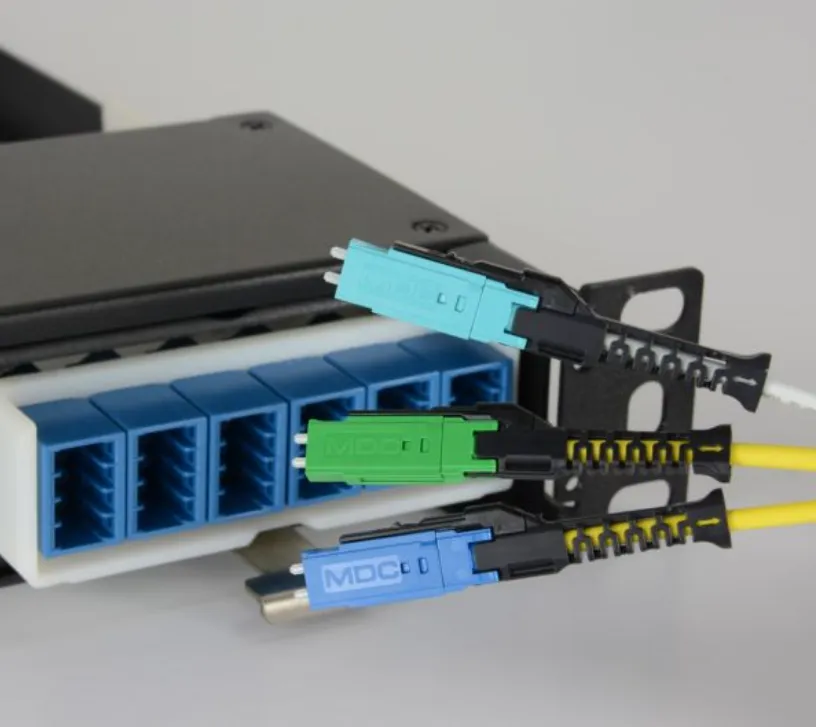
As data centers and communication networks continue to grow in speed and complexity, there’s increasing pressure to fit more connections into tighter spaces without compromising performance. One component helping meet these demands is the MDC connector—a compact, high-density option quickly gaining popularity in modern fiber optic systems.
If you’re new to fiber connectivity or simply want a clearer understanding of MDC technology, this guide explains what these connectors are, how they function, and why they’re becoming essential in next-generation networks.
What Is an MDC Connector?
MDC stands for Miniature Duplex Connector. It’s a small, dual-fiber connector designed to deliver duplex connectivity—one fiber for transmitting and one for receiving—in a much smaller footprint than traditional duplex connectors. Like the well-known LC connector, it uses a 1.25 mm ferrule, but its housing is considerably more compact.
Developed to meet TIA-604-18 (FOCIS 18) standards, the MDC connector features a push-pull design that allows technicians to plug or remove it even in densely populated panels where space is limited.
Why MDC Connectors Were Created
The growth of cloud computing, AI, streaming services, and other bandwidth-intensive technologies has led to a dramatic rise in fiber port density requirements. Older connector styles, such as LC duplex, take up too much physical room to keep pace with these emerging demands.
MDC connectors were engineered to:
- Provide far greater port density
- Reduce the space needed for patching
- Streamline cable organization in high-density racks
In short, they allow more connections to fit in the same physical area—an essential advantage in large data centers.
Inside the Design: How MDC Connectors Work
MDC connectors combine small size with flexible design features:
- Ferrule: 1.25 mm zirconia ferrule, same as LC
- Connector format: Duplex, supporting two fibers
- Polarity options: Easily reversible without special tools
- Push-pull tab: Enables simple insertion and removal even in tight areas
Despite their miniature size, MDC connectors offer excellent optical performance—low insertion loss and high return loss—making them suitable for today’s fastest optical modules, including 400G and 800G transceivers.
Key Advantages of MDC Connectors
Several features make MDC connectors increasingly attractive for high-performance networks:
- Exceptional density: Three MDC ports can fit in the space normally used by one LC duplex port
- Quick polarity changes: Zero tools required
- User-friendly handling: Push-pull design simplifies installation
- Reliable signal performance: Meets stringent optical specifications
- Cleaner cable management: Smaller connectors improve airflow and reduce congestion
These strengths make them particularly useful where space and efficiency matter most.
Where MDC Connectors Are Used
MDC connectors are gaining traction across multiple network environments, including:
- Hyperscale and colocation data centers
- 5G and edge computing networks
- High-bandwidth telecom installations
- Systems using SFP-DD, OSFP, or QSFP-DD transceivers
- Any setup transitioning to 400G or 800G data rates
Their ability to pack more fiber connections into a limited area aligns perfectly with today’s expanding infrastructure.
Benefits of Choosing MDC Technology
Network designers value MDC connectors for several reasons:
- Maximizes rack capacity without adding physical footprint
- Prepares networks for future upgrades, especially high-speed optics
- Reduces installation time with easy push-pull access
- Improves cooling efficiency, thanks to less bulky cabling
- Compatible with advanced transceivers and breakout designs
These advantages collectively support scalable, long-term growth.
Tips for Working With MDC Connectors
To ensure the best results when installing or maintaining MDC connections:
- Keep connectors clean and inspect ferrules before mating
- Avoid sharp bends in the cable
- Label connections to prevent confusion in high-density areas
- Route and secure cables to avoid strain on the connector
- Work in clean, dust-free environments whenever possible
Good handling practices maintain performance and prolong network reliability.
Should You Use MDC Connectors?
MDC connectors make the most sense in high-capacity environments that require dense patching and future-ready infrastructure. If your network is moving toward 400G or beyond, or if you’re redesigning a data center for better efficiency, MDC offers meaningful advantages.
For smaller networks or legacy systems, however, traditional LC connectors may still be the simpler and more cost-effective option.
The Growing Role of MDC in Modern Fiber Networks
As networks evolve toward higher speeds and increased layering of services, MDC connectors are becoming an important part of the industry’s shift toward modular, scalable designs. Rather than replacing LC connectors entirely, MDC technology expands the options available for building dense, efficient fiber networks.
Conclusion
The MDC connector represents a significant advancement in fiber connectivity. By combining a compact form, easy handling, and excellent performance, it supports the high-density, high-speed environments that define modern networking. Whether you’re upgrading a data center or exploring next-generation fiber solutions, understanding how MDC connectors work can help you make more informed decisions and create a more efficient, future-ready infrastructure.
