



As the demand for faster, cleaner, and more responsive communication continues to grow, breakthroughs in optical fiber technology are becoming increasingly important. One development gaining major attention across the telecom, research, and technology sectors is ultra-low attenuation hollow core fiber (HCF). This emerging fiber type offers a fundamentally different way of transmitting light—one that could transform the performance of future communication networks.
In this blog, we’ll look at what hollow core fiber is, how it works, and why it represents a significant step forward for high-speed optical systems.
What Is Hollow Core Fiber?
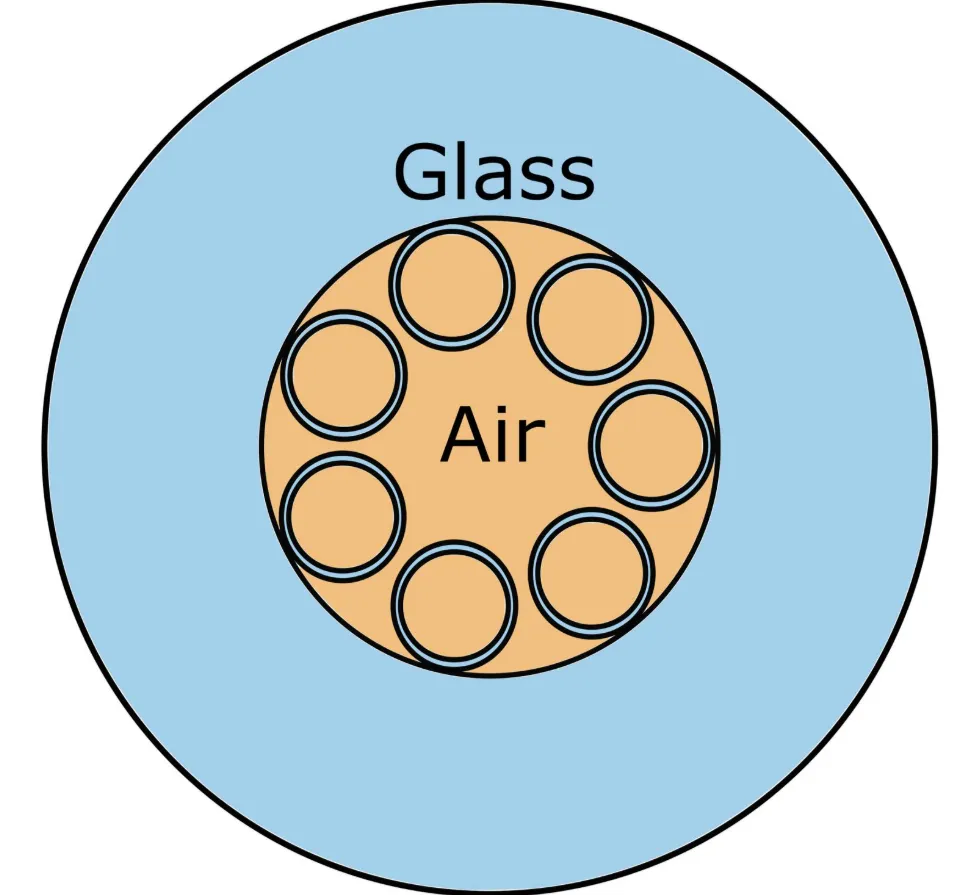
Traditional optical fibers guide light through a solid glass core. Hollow core fiber takes a new approach by transmitting light through an air-filled central region. The surrounding structure, made from carefully engineered photonic materials, keeps the light confined inside the hollow core.
Because light travels through air rather than glass, the signal experiences far less absorption and distortion. This design dramatically reduces attenuation and opens the door to much faster, lower-latency communication.
Understanding Ultra-Low Attenuation
Attenuation refers to the gradual loss of signal strength as light moves through a fiber. Standard single-mode fibers typically have attenuation values around 0.2 dB/km at common telecom wavelengths.
Recent advances in hollow core design have pushed attenuation levels even lower—down to around 0.14 dB/km in some demonstrations. At these extremely low levels, HCF competes with the best solid-core fibers while also offering:
- Faster light propagation
- Reduced latency
- Minimal nonlinear distortions
These improvements are especially useful in applications where timing and signal clarity are critical, such as financial exchanges, advanced data centers, and next-generation wireless networks.
How Hollow Core Fiber Works
Hollow core fiber relies on specialized structures that guide light without relying on total internal reflection. Two main mechanisms make this possible:
- Photonic Bandgap structures: A repeating pattern in the cladding prevents light from escaping, trapping it within the hollow center.
- Anti-resonant designs: Thin, ring-shaped capillaries surrounding the core reflect light inward through interference, keeping it confined.
Both approaches limit the amount of light that interacts with physical material—reducing loss, dispersion, and unwanted nonlinear effects.
Advantages Over Traditional Fiber
Ultra-low attenuation hollow core fiber brings several benefits that go beyond what conventional fibers can offer:
Lower latency:
Light travels faster in air, reducing round-trip delays and improving responsiveness for time-critical applications.
Reduced nonlinear effects:
Since most of the transmission occurs in air, issues like nonlinear phase distortion are greatly minimized.
Lower attenuation:
Modern HCF performs similarly to top-tier solid-core fibers but with less signal degradation and fewer repeaters needed over long distances.
Improved signal quality:
With minimal interaction between the signal and the fiber material, signals retain more of their original clarity.
Broadband operation:
Many HCF designs support wide wavelength ranges, making them suitable for dense wavelength-division multiplexing (DWDM) systems.
Where Hollow Core Fiber Can Be Used
Ultra-low attenuation HCF has the potential to reshape many high-performance network environments:
Data centers:
Ideal for connecting servers or facilities that require extremely low latency and high throughput.
5G and future wireless networks:
Supports faster backhaul connections for emerging radio technologies.
High-frequency trading:
Speed is everything in financial markets, and the reduced latency of HCF offers a measurable advantage.
Quantum communication:
Low noise and low dispersion make HCF suitable for sensitive quantum key distribution systems.
AI infrastructure:
As AI clusters grow, rapid data movement between compute nodes becomes increasingly important.
Current Challenges
Despite its potential, hollow core fiber still faces obstacles before it can be widely deployed:
- Manufacturing the intricate structures is complex
- Costs remain higher than standard single-mode fiber
- Specialized connectors may be required
- Large-scale production isn’t yet standardized
However, ongoing research and commercial interest continue to bring HCF closer to mainstream use.
The Future of Fiber Networks
Ultra-low attenuation hollow core fiber signals a major shift in optical communication. As data traffic accelerates and new technologies demand ever-lower latency, HCF provides a path forward that traditional fibers can’t easily match.
From global trading routes to high-capacity AI systems and ultra-secure communication channels, hollow core fiber could become a defining technology of next-generation networks.
Final Thoughts
Hollow core fiber represents one of the most exciting advancements in optical communication. By enabling light to travel faster, cleaner, and with less interference, it promises a future of unprecedented network performance. Whether powering tomorrow’s telecom backbones or enabling cutting-edge scientific breakthroughs, ultra-low attenuation HCF is poised to play a central role in the evolution of digital connectivity.
