



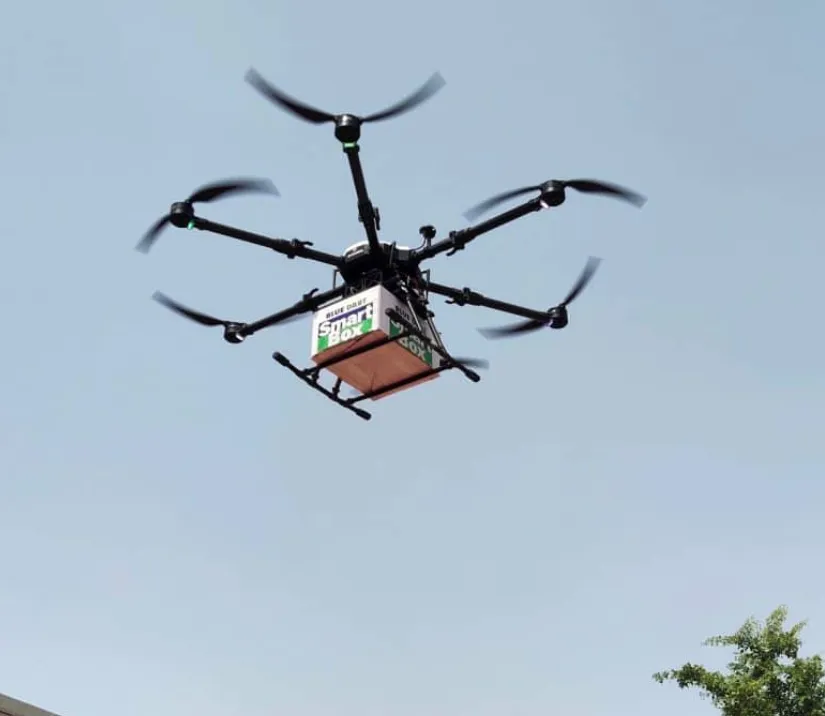
Blue Dart, one of India’s leading logistics companies and part of the Deutsche Post DHL Group, has taken a significant step toward transforming healthcare delivery in remote regions. Under the Blue Dart Med-Express Consortium, the company has officially started its Visual Line of Sight (VLOS) and Beyond Visual Line of Sight (BVLOS) drone trials in Vikarabad, Telangana. The first phase began on September 9, 2021, marking an important moment in India’s journey toward drone-enabled medical logistics.
These trials are being conducted as part of the Telangana Government’s “Medicine from the Sky” initiative, a program aimed at exploring how drones can improve last-mile access to essential medical supplies. The early results have been encouraging, demonstrating the potential to deliver vaccines, emergency medicines, diagnostic samples, and other lifesaving materials swiftly to hard-to-reach areas.
A Step Toward Next-Generation Healthcare Logistics
The launch event saw the presence of key national and state leaders, including the Union Minister of Civil Aviation and senior officials from Telangana. Their participation underscored the importance of drone technology in strengthening healthcare distribution networks across the country.
Formed earlier in the year, the Blue Dart Med-Express Consortium aims to bring drones into mainstream logistics, particularly for urgent medical deliveries. The project is supported by the Government of Telangana and developed in collaboration with the World Economic Forum, Niti Aayog, and Healthnet Global. With this initiative, Blue Dart hopes to develop solutions that ensure rapid access to healthcare even in the most remote parts of India.
Leadership Speaks on a Tech-Forward Future
Blue Dart’s Managing Director, Balfour Manuel, highlighted the company’s commitment to adopting emerging technologies that make logistics more reliable and accessible. He emphasized that participating in “Medicine from the Sky” offers an opportunity to build a stronger healthcare system for underserved regions. He expressed optimism about extending drone-based delivery services across the country in the future.
Ketan Kulkarni, Blue Dart’s CMO and Head of Business Development, echoed this sentiment by noting how technology has become central to the logistics industry. He stated that these trials are only the beginning of what Blue Dart intends to explore as it works toward strengthening India’s supply chain infrastructure.
How the Drone Trials Work
During the trials, multi-rotor drones were deployed to transport vaccines from Vikarabad to a primary healthcare center in Sidduloor. Each drone can travel up to 10 kilometers per flight at speeds of roughly 32 km/h. Between six to seven VLOS flights (covering up to 1 km) and four to five BVLOS flights (covering up to 9 km) were conducted each day.
These drones are capable of carrying Blue Dart’s temperature-controlled medical shipments, supporting payloads of up to 5 kilograms. Their ability to navigate difficult terrains makes them well-suited for operations in remote or elevated regions where traditional logistics struggle.
Strengthening India’s Healthcare Supply Chain
Blue Dart’s role during the COVID-19 pandemic highlights how essential logistics companies are during national emergencies. The company played a crucial part in transporting critical supplies—ranging from PPE kits and medicines to lab samples and vaccines—under the Government of India’s “Lifeline Udan” mission. Blue Dart also supported international movement of medical supplies between India and countries such as China, Bangladesh, Hong Kong, Myanmar, Bhutan, and Albania.
Additionally, the company has deployed charter flights to move essential equipment like oxygen concentrators, ventilators, and oximeters. This experience forms the foundation for the Med-Express drone initiative, which aims to create a more responsive and efficient healthcare logistics model.
With its drone trials now underway, Blue Dart is preparing to play an even larger role in India’s evolving medical delivery network. The company hopes to implement a scalable drone-based system that strengthens healthcare access in rural and deep-rural regions—ultimately improving the nation’s ability to respond quickly during emergencies.
