



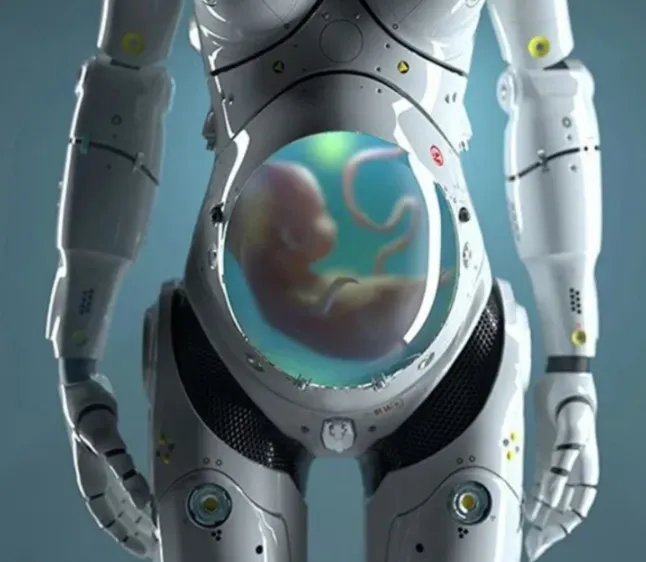
China is working on a groundbreaking innovation that could revolutionize the field of medical science: a humanoid robot capable of carrying a baby for nine months and giving birth. If successful, this development could redefine the concepts of fertility, family, and even birth itself.
What Is the Pregnancy Robot?
Reports from Chinese tech media indicate that the world’s first pregnancy robot is being developed by Dr. Zhang Qifeng from Singapore’s Nanyang Technological University. Unlike premature baby incubators, this humanoid robot is designed to replicate the entire pregnancy process, from conception to birth.
At the heart of the robot’s design is artificial womb technology. The robot’s abdomen would contain a synthetic womb filled with artificial amniotic fluid, simulating the natural conditions of the human uterus. A nutrient delivery system, similar to a placenta, would sustain the fetus throughout the gestation period, ensuring it grows as it would in a biological mother.
The Science Behind the Artificial Womb
Artificial womb technology is not entirely new. In earlier experiments, scientists successfully grew a premature lamb in a “biobag,” where it developed wool and thrived. Dr. Zhang’s team aims to take this technology further, transitioning from animal models to a humanoid robot capable of sustaining human life in an artificial womb.
Dr. Zhang explained, “The artificial womb technology is already well-developed, and now it needs to be integrated into the robot’s abdomen, enabling interaction between the robot and the human life inside, allowing the fetus to grow within.”
Prototype, Timeline, and Costs
The first prototype of the pregnancy robot is expected to be ready as early as next year. Reports estimate that the project could cost around 100,000 yuan (approximately ₹12.96 lakh), making it a costly but potentially transformative piece of technology.
Ethical and Legal Implications
While the scientific progress is groundbreaking, the concept raises significant ethical and legal concerns. Questions about societal acceptance of babies born from robots, and the impact on traditional concepts of parenthood and family, are at the forefront of the discussion. Dr. Zhang revealed that talks are already underway with officials from Guangdong Province, where draft regulations and policies are being developed to address these concerns.
A Milestone in Human Science?
If successful, this innovation could dramatically alter medical science, fertility treatments, and reproductive health. However, it could also ignite global debates on the ethics, laws, and the very definition of life. As the project moves forward, it is likely to spark a broader conversation about the future of human reproduction and the role of technology in shaping it.
