



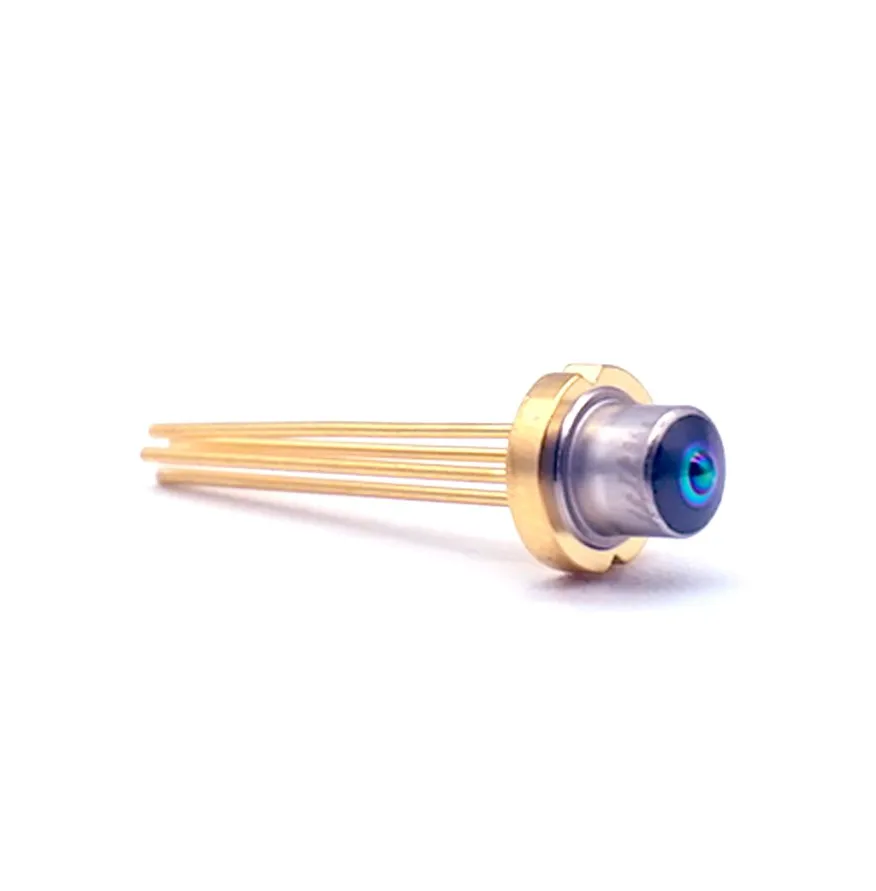
In a world where enormous amounts of data travel across the globe in fractions of a second, the technology behind this connectivity is more important than ever. At the core of today’s ultra-fast fiber-optic networks are Distributed Feedback (DFB) laser diodes—precise, stable light sources that make reliable long-distance data transmission possible. Their single-mode output, narrow linewidth and exceptional wavelength stability have made them essential components in the modern communications landscape.
What Exactly Is a DFB Laser Diode?
A DFB laser diode is a semiconductor laser designed with an internal diffraction grating that replaces the mirrors used in traditional laser structures. This built-in grating acts as a wavelength-selective reflector, allowing only one wavelength to be reinforced and amplified. As a result, the device produces a clean, stable single-mode output—a key requirement for high-speed, long-distance optical communication.
Unlike Fabry–Perot lasers that emit several wavelengths at once, DFB lasers focus all their energy on one narrow spectral line, creating a more efficient and reliable signal.
How DFB Lasers Work
Inside the diode, a periodic grating pattern is etched directly into the semiconductor material. When electrical current flows through the active layer, light is generated. The grating then reinforces the wavelength that meets the Bragg condition, suppressing all others. This mechanism ensures the laser maintains a stable emission even as temperatures or operating conditions change.
This precision control is what makes DFB lasers so valuable for transmitting data at high speeds over long distances.
Key Characteristics of DFB Laser Diodes
DFB lasers are built to deliver exceptional performance in demanding fiber-optic environments. Some of their standout features include:
- Stable single-mode operation: Ensures clean data transmission with minimal interference.
- Very narrow linewidth: Often just a few MHz, essential for high-bit-rate systems.
- Excellent wavelength stability: Keeps signals consistent even as temperature or current varies.
- High modulation capability: Supports higher data rates for fast communication links.
- Compact and efficient design: Easy to integrate into optical modules and requires less power than many alternatives.
Why DFB Lasers Are Vital for Optical Communication
As data consumption skyrockets—driven by cloud services, video streaming, 5G networks and IoT devices—communication networks must keep up. DFB lasers enable this by offering the performance required for advanced fiber-optic systems.
High-Speed Data Delivery
Thanks to their narrow linewidth and high modulation speed, DFB lasers support gigabit and even terabit data rates across large-scale networks.
Reliable Long-Distance Transmission
Since the signal remains stable and low-noise, light can travel across long fiber routes with reduced degradation. Combined with optical amplifiers, this makes DFB lasers ideal for long-haul communication lines.
Precision in Wavelength Division Multiplexing
WDM systems rely on sending multiple wavelengths down a single fiber. DFB lasers, with their tightly controlled output, minimize interference and allow dense channel spacing.
Compatibility with Modern Modulation Formats
Advanced techniques like QAM and PSK require lasers that can maintain stable output under complex modulation. DFB lasers deliver the stability needed for these sophisticated systems.
Where DFB Laser Diodes Are Used
Although they are best known in telecom applications, DFB lasers serve many other fields:
- Fiber-optic communication systems
- CATV networks for high-quality signal distribution
- Data centers to link high-capacity switches and servers
- Environmental monitoring and spectroscopy
- LIDAR systems requiring precise wavelength output
- 5G backhaul networks demanding ultra-fast data links
Their precision and reliability make them suitable for any application that depends on accurate optical transmission.
Recent Innovations in DFB Technology
The world of DFB lasers continues to evolve, with new developments improving their performance and adaptability:
- Temperature-compensated lasers for stable operation in varying conditions
- Tunable DFB devices that adjust wavelengths dynamically for flexible WDM networks
- Integrated modules combining the laser, electronics and isolators in compact packages
- Quantum-dot and quantum-well DFB lasers offering enhanced thermal efficiency and lower threshold currents
These advancements are expanding the role of DFB lasers in emerging technologies such as quantum communication and advanced photonics.
Challenges and What the Future Holds
Despite their strengths, DFB lasers come with some challenges, including manufacturing complexity and temperature sensitivity. Research is focused on cost-efficient production, silicon-photonics integration and smarter wavelength-control technologies.
The next era of DFB development is likely to see:
- Greater integration with photonic chips for compact, high-density networks
- Automated wavelength optimization through AI-driven systems
- More energy-efficient designs supporting greener communications infrastructure
As global data demand continues to climb, the importance of DFB laser diodes will only grow.
Final Thoughts
DFB laser diodes are fundamental to the performance of modern optical networks. Their precise single-mode output, high stability and exceptional speed make them the backbone of today’s high-capacity digital communication systems. As the world moves toward 6G, cloud-based economies and increasingly connected environments, DFB lasers will remain at the heart of the optical technologies that keep our world linked.
