



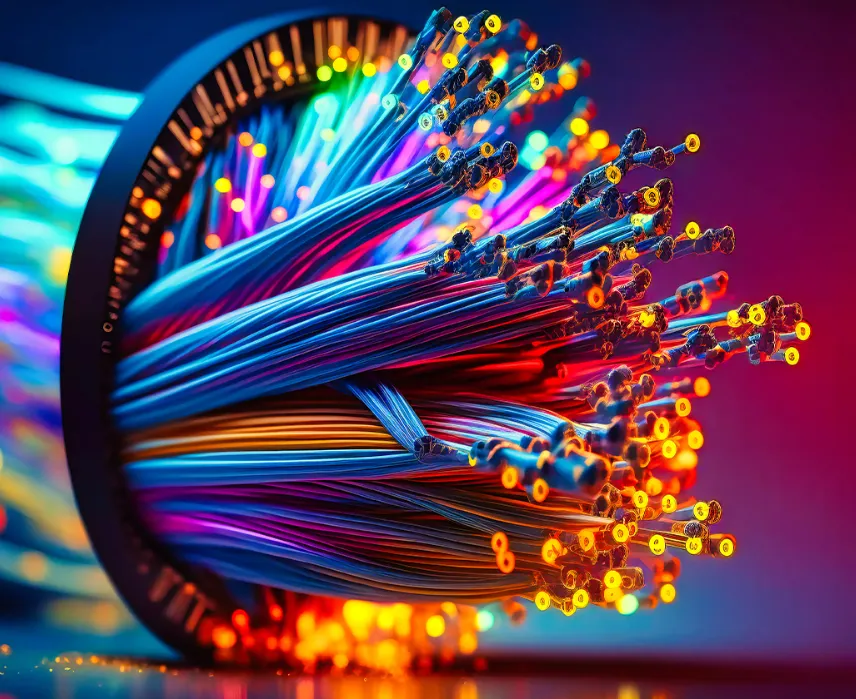
In today’s hyperconnected world, the demand for faster and more dependable communication continues to grow. From streaming high-definition content to enabling real-time financial transactions, the digital infrastructure that supports these services depends heavily on fiber optic technology. Acting as the backbone of global telecommunications, fiber optics has revolutionized how information travels, enabling higher speeds, greater capacity, and unmatched reliability.
This article takes a closer look at how fiber optics powers the telecom industry, its advantages over traditional systems, and the trends shaping its future.
What Is Fiber Optic Technology?
Fiber optics is a communication technology that transmits data using light pulses through ultra-thin strands of glass or plastic fibers. Unlike copper cables, which rely on electrical signals, fiber uses light to carry vast amounts of information quickly and efficiently over long distances. Each strand of fiber is thinner than a human hair yet capable of transmitting terabits of data per second.
At its core, a fiber optic cable consists of a core, which carries the light, surrounded by cladding that keeps the light within the core through reflection. This structure ensures minimal signal loss, even across vast distances.
Why Fiber Optics Has Redefined Telecommunications
Telecom networks were once dominated by copper cabling, which served well for voice communication but struggled to meet the rising demands of data-heavy applications. As global data consumption surged with the rise of cloud computing, 5G, and IoT, fiber optics became the clear successor.
Here’s why fiber optics now serves as the foundation of modern telecom:
1. Unmatched Transmission Speed
Fiber optics transmit data at nearly the speed of light, allowing for lightning-fast internet and real-time communication.
2. High Bandwidth Capacity
Fiber supports significantly higher data volumes than copper, enabling seamless video conferencing, large-scale cloud storage, and other bandwidth-intensive applications.
3. Greater Reliability
Fiber cables are immune to electromagnetic interference and environmental noise, maintaining consistent performance even under challenging conditions.
4. Long-Distance Efficiency
With extremely low signal attenuation, fiber optics can transmit data across kilometers without requiring frequent amplification.
5. Scalability and Future Readiness
As data requirements grow, fiber infrastructure can be easily upgraded, ensuring it remains a viable solution for decades to come.
Key Applications in Telecom Networks
The versatility of fiber optics has made it indispensable across the telecommunications landscape. From home internet to international connectivity, its applications are vast and far-reaching.
Residential Internet (FTTH)
Fiber-to-the-Home (FTTH) technology has transformed residential broadband, offering gigabit-speed internet ideal for streaming, gaming, and remote work. Telecom operators increasingly replace DSL and coaxial lines with fiber to meet growing customer expectations.
Mobile Backhaul and 5G Infrastructure
The success of 5G depends on fiber connectivity. Fiber cables provide the high-capacity, low-latency backbone needed to connect cellular towers and support real-time data processing for next-generation mobile networks.
Enterprise Communications
Businesses depend on fiber for high-speed, secure, and stable communication. It supports applications such as cloud computing, remote collaboration, and VoIP with superior reliability.
Global Connectivity via Submarine Cables
Thousands of kilometers of undersea fiber optic cables form the backbone of the global internet, carrying the majority of international data traffic. These cables link continents, enabling global communication and commerce.
Smart Cities and IoT Networks
Fiber optics also powers smart city initiatives, connecting IoT devices, surveillance systems, and traffic sensors. High-speed data transfer allows for real-time analytics and efficient city management.
Benefits of Fiber Optics in Telecom
Beyond performance and speed, fiber optics offer a range of operational and environmental benefits that make them the preferred choice for network operators:
- Enhanced Security: Fiber cables are difficult to tap or intercept, making them ideal for transmitting sensitive data.
- Durability: Resistant to corrosion, weather, and electromagnetic interference, fiber cables are built for long-term reliability.
- Energy Efficiency: Fiber systems consume less energy than copper-based networks, contributing to greener telecom infrastructure.
- Scalability: Fiber networks can be expanded with minimal physical upgrades, providing long-term cost savings.
Challenges in Fiber Deployment
While the benefits are clear, deploying fiber infrastructure presents certain challenges that slow its global rollout:
- High Upfront Costs: Installing fiber networks involves significant initial investment in trenching and cabling.
- Complex Installation: Fiber deployment requires specialized tools and expertise.
- Physical Vulnerability: Despite their durability, fibers can still be damaged by construction or natural events.
- Limited Access in Remote Areas: Extending fiber networks to rural or hard-to-reach regions remains costly and logistically challenging.
The Future of Fiber Optics in Telecom
As digital transformation accelerates, the importance of fiber optics in telecommunications will only increase. The following trends highlight what lies ahead:
- Integration with 5G and 6G: Fiber will continue to serve as the backbone for emerging mobile technologies requiring ultra-low latency and immense data capacity.
- Growth of Cloud and Data Centers: As more businesses migrate to cloud computing, fiber will provide the high-speed connectivity required for seamless operations.
- Advancements in Submarine Cable Systems: New materials and designs will expand global data capacity and improve redundancy.
- Sustainable Networking: Fiber’s low power consumption will help telecom providers achieve greener, more energy-efficient operations.
- Expansion of Smart Infrastructure: Fiber connectivity will support advanced IoT ecosystems and autonomous urban systems.
Conclusion
Fiber optic technology is not just an upgrade—it’s the foundation of the digital era. Its ability to deliver high-speed, secure, and scalable connectivity makes it indispensable for everything from home broadband to global communications. Although installation challenges and initial costs remain, the long-term advantages of fiber—speed, durability, efficiency, and sustainability—make it the most future-ready telecom solution available.
As innovations like 5G, IoT, and AI continue to expand, fiber optics will remain the driving force behind a faster, more connected world. For businesses, governments, and consumers alike, investing in fiber technology is an investment in the future of global communication.
