



Optical fiber has been the backbone of modern communication for decades, carrying enormous amounts of data across cities, continents, and oceans. But as our need for speed and capacity continues to grow—driven by cloud computing, AI, 5G, and high-density data centers—traditional single-core fiber is approaching its performance ceiling.
Two emerging technologies are paving the way for the next era of ultra-fast communication: hollow-core fiber and multicore fiber. These advanced designs promise major improvements in bandwidth, latency, and overall network efficiency. Let’s explore what makes them different and why they matter.
The Push Beyond Conventional Optical Fiber
Standard optical fibers use a solid glass core to guide light. This design has served the industry well, but it still introduces certain limitations such as dispersion, nonlinear distortion, and delays caused by light traveling through glass rather than air. As data demands surge, engineers are turning toward new fiber structures that can overcome these inherent constraints.
What Makes Hollow-Core Fiber Unique?
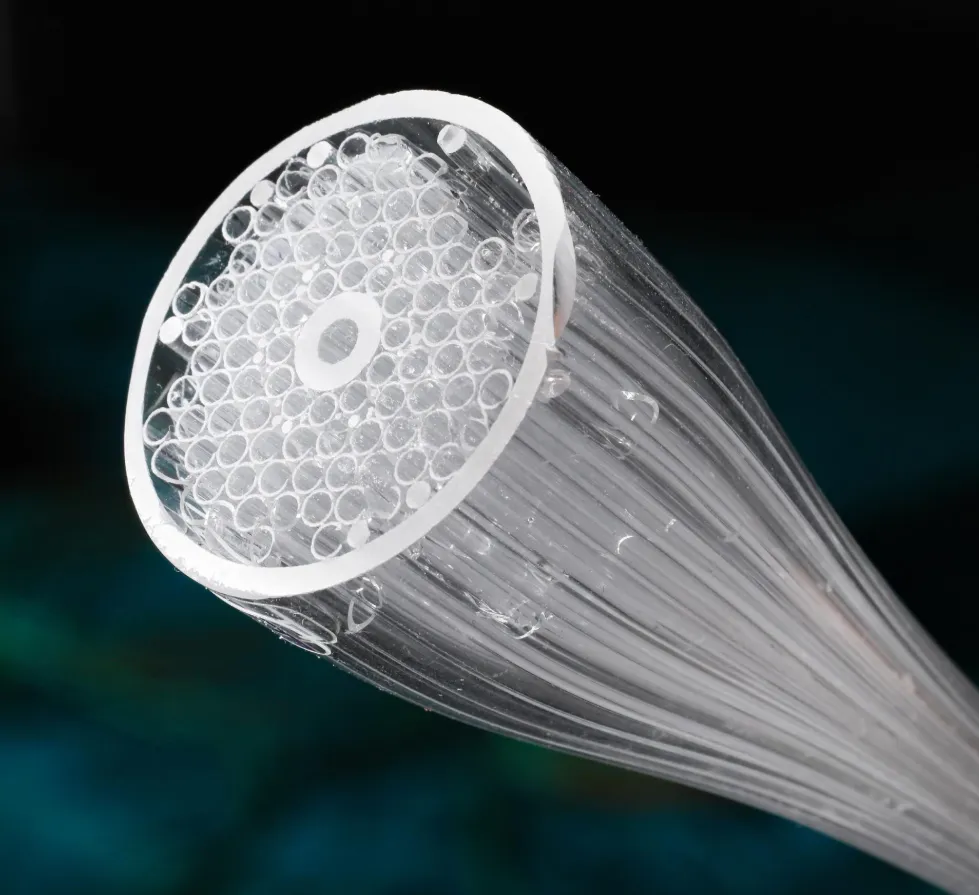
Hollow-core fiber (HCF) replaces the solid glass center with a hollow channel. Light travels through this air-filled pathway instead of a solid medium, which changes the physics of transmission in several important ways.
How it works:
A specially engineered cladding structure around the hollow core reflects light inward using advanced photonic designs. Instead of bouncing through glass, the signal moves through air with far fewer distortions.
Key benefits:
- Lower latency: Light moves faster in air than through glass, reducing transmission delays.
- Reduced signal distortion: With less interaction with solid material, nonlinear effects are dramatically minimized.
- Higher power capability: Ideal for intense laser applications.
- Lower loss at specific wavelengths: Emerging designs show promising improvements in long-distance performance.
Where it’s used:
- High-performance data centers
- Ultra-fast financial trading networks
- Aerospace and defense communication
- Medical laser systems
- Quantum-safe communication links
What Sets Multicore Fiber Apart?
Instead of one core per cable, multicore fiber (MCF) houses several independent cores within a single cladding. Each core functions like a separate communication channel, allowing multiple data streams to run in parallel.
How it works:
Every core carries its own signal, and careful spacing or special structural designs prevent unwanted interference between them.
Types of MCF:
- Uncoupled: Each core operates independently with low crosstalk.
- Coupled: Cores interact intentionally for advanced multiplexing techniques.
Key advantages:
- Massive capacity gains: One cable can carry many times more data than standard fiber.
- Space-efficient installation: Reduces the number of physical cables required in dense networks.
- Improved long-term cost efficiency: Less trenching, fewer ducts, and streamlined infrastructure.
Ideal applications:
- Backbone networks
- Undersea communication systems
- High-density data centers
- Future 6G transport networks
Challenges Slowing Widespread Adoption
Even though these technologies are promising, they aren’t without hurdles:
- Complex manufacturing: Both fiber types require high-precision fabrication processes.
- Higher initial cost: Prices are expected to decrease as adoption grows.
- New infrastructure requirements: Specialized connectors, splicing tools, and amplifiers are needed.
- Evolving standards: Industry regulations and interoperability guidelines are still developing.
Why These Technologies Matter for the Future
Next-Generation Telecom:
As mobile networks evolve toward 6G and beyond, ultrafast and low-latency backhaul links will be essential—making HCF and MCF strong contenders for future deployment.
Data-Driven Industries:
AI and big-data workflows thrive on low latency and massive bandwidth. Both fiber types offer exactly that.
Quantum Communication:
Hollow-core fibers reduce noise and nonlinear distortions, making them attractive for quantum key distribution and other secure communication methods.
Aerospace and Defense:
Lightweight, low-latency, and high-power-capable fibers open new possibilities for advanced communication systems in harsh environments.
Recent Breakthroughs
- Hollow-core designs with antiresonant structures have achieved record low latency and low signal loss.
- Multicore prototypes with 7, 12, or more cores are being tested for long-haul applications.
- Global research collaborations are accelerating standardization and real-world trials.
Final Thoughts
Hollow-core and multicore fibers represent two of the most exciting advancements in optical communication. By pushing beyond the limitations of traditional single-core fiber, they promise networks that are faster, more efficient, and more capable of supporting the technologies of tomorrow.
As costs decrease and infrastructure evolves, these advanced fibers are likely to become foundational elements of next-generation telecom systems, global data networks, and emerging scientific applications. In many ways, they’re shaping the blueprint for the future of connectivity.
